Suggestions 🔥
Bestsellers ❤️
You're from unlocking Congratulations! You've unlocked
Extra 10% Off
Extra 15% Off
Menu
Best Sellers
Cast Iron Cookware →
Ceramic Cookware →
Hybrid Cookware →
12 Colours →
5 Colours →
7 Colours →
6 Colours →
8 Colours →
8 Colours →
5 Colours →
6 Colours →
5 Colours →
8 Colours →
7 Colours →
7 Colours →
9 Colours →
6 Colours →
8 Colours →
7 Colours →
7 Colours →
7 Colours →
5 Colours →
5 Colours →
5 Colours →
5 Colours →
5 Colours →
5 Colours →
5 Colours →
5 Colours →
8 Colours →
7 Colours →
7 Colours →
4 Colours →
6 Colours →
5 Colours →
4 Colours →
6 Colours →
8 Colours →
EOFY SALE: Up to 50% OFF
Spend $250+ Get Extra 10% OFF
Spend $550+ Get Extra 15% OFF
EOFY SALE: Up to 50% OFF
Spend $250+ Get Extra 10% OFF
Spend $550+ Get Extra 15% OFF
EOFY SALE: Up to 50% OFF
Spend $250+ Get Extra 10% OFF
Spend $550+ Get Extra 15% OFF
I have two kids. The older one is six and the younger is sixteen months. The older one eats food cooked in our pans roughly four times a day. The younger one has just started solids. And about three months ago, I started reading the labels on the cookware I was using — not the marketing on the box, the actual labels — and what I found made me audit the entire kitchen on a Sunday afternoon.
Three pans went in the bin that night. Two went to a recycling drop-off. One — the one I'd had the longest, that I'd used to cook my older daughter's first solid food — was the one that took me a week to throw out. Here's what I learned, and what I bought to replace them.
It started with a podcast. A materials scientist talking about why PFAS — the family of "forever chemicals" that's been in the news for the last decade — is more pervasive in kitchenware than most people realise. He mentioned that most cookware brands have phased out PFOA (perfluorooctanoic acid) but not the broader PFAS family. He said "PFOA-free" had become a marketing claim that means almost nothing in 2026.
I'd never heard of any of this. I went home, took every non-stick pan out of the cupboard, and lined them up on the counter.
Six pans, four brands. Three of them said "PFOA-free" on the bottom. None of them said "PFAS-free." Two had no markings at all — I couldn't even tell what the coating was made of, because the brand had been so generic that I'd thrown the paperwork out years ago.
My older daughter's first solid foods had been cooked in one of the unmarked ones.
I spent the next week reading. Some of what I found:
PFOA-free is not PFAS-free. PFOA was phased out of cookware manufacturing globally over a decade ago. Most non-stick brands now market themselves as "PFOA-free" — which is true and effectively meaningless, because PFOA isn't what people are worried about anymore. The broader PFAS family is the current concern.
Ceramic non-stick isn't always safer. Many ceramic coatings are still applied with PTFE-based binders. "Ceramic" describes the surface, not the entire coating system. Some are genuinely PFAS-free; many aren't. The only way to know is to find a brand that publishes its certifications.
Scratches matter. Once a non-stick coating is scratched, food is in contact with whatever's underneath. For PTFE coatings, that's the metal base. For ceramic, it depends on the construction. Either way, the cooking surface is no longer the surface the manufacturer tested for safety.
Most brands won't show you their certifications. I emailed two of the brands whose pans I owned, asking for their SGS and CAL65 test results. One didn't reply. The other sent a generic "non-toxic" PDF that didn't address my question.
By the end of the week, I'd made up my mind. The three pans whose coatings I couldn't verify went in the bin. The two I could verify went to recycling. The last one — the one from my daughter's first foods — I kept in the cupboard for another five days before I could bring myself to let go of it. Sentimental reasons. Not logical ones.
Replacing six pans isn't cheap. I wanted to do it once and do it right. The criteria I worked out:
I started looking. Most premium brands met the first three criteria. The fourth criterion was where everything fell apart — almost no non-stick pan on the Australian market is genuinely metal-utensil-safe, because the coating sits directly on the cooking surface and metal scratches it.
Then I came across CrumbleCoat™ by Crumble. An Australian brand I'd vaguely heard of through their Dutch ovens, but didn't realise had a hybrid range.
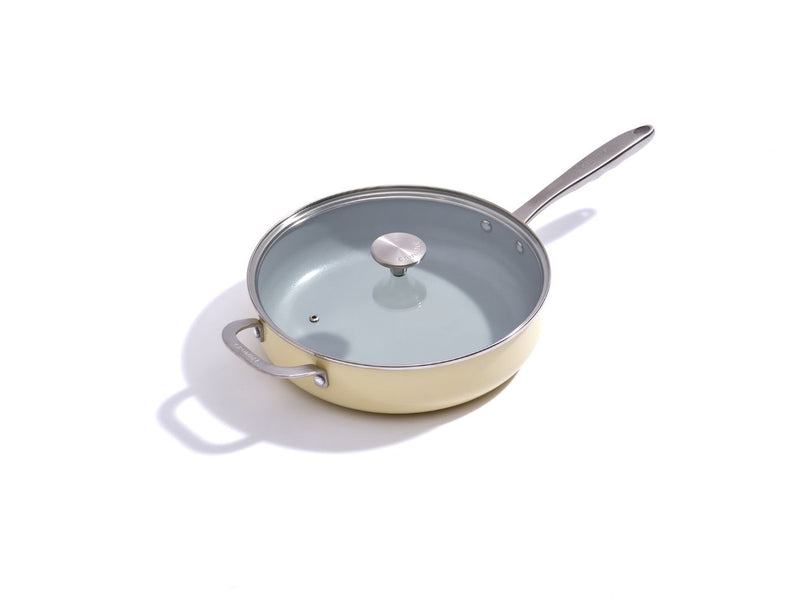
CrumbleCoat™ is structurally different from a normal non-stick pan. The cooking surface is laser-etched into a pattern of raised stainless steel peaks and non-stick valleys. The peaks are stainless. The valleys are non-stick. The food touches both.
This matters for two reasons. First, it means when the pan eventually wears (and all non-stick eventually wears), the stainless peaks remain a food-safe cooking surface. Second, it means the pan can handle metal utensils — the peaks take the abuse, the valleys are protected.
The coating is PFAS-free, lead-free, and free from harmful chemicals — the actual claim parents should be looking for. The pan is SGS-certified, FDA-compliant, oven-safe, and induction-compatible. The warranty is two years on a category where most warranties are twelve months.
Crumble themselves have over 60,000 customers across their cookware range, more than 5,000 five-star reviews, and a 30-day home trial. The brand is established enough that the certifications hold up, but specific enough that the technology is genuinely differentiated.
I bought the 12-piece Family Set. It's been three months. Here's the report.
The pan handles everything I cook in it. Eggs in the morning — no sticking, no flaking. Searing chicken thighs — the stainless peaks do what they're supposed to do, the food browns properly, and cleanup is the same as any non-stick. Pasta sauce — the deep walls of the sauté pan handle a full pot of bolognese without splatter.
My older daughter, the six-year-old, scrapes the pan with a metal spatula constantly. I have stopped flinching. The surface still looks like new. The gingham pattern is exactly the same as the day it arrived.
The younger one is now eating solid foods cooked in pans whose coating I can verify, whose certifications I've seen, and whose construction means a scratch won't put me back at square one. This is what I was looking for.
If your non-stick pans are older than three years and showing scratches: replace them. The risk-to-benefit calculation has shifted in the last five years, and what was acceptable in 2019 is no longer the most cautious choice in 2026.
If you're going to replace them, replace them with cookware whose certifications you can verify. Don't trust marketing words. "Non-toxic" means nothing. SGS, FDA, CAL65 — these are real.
And if you're going to buy hybrid: CrumbleCoat™ is, as far as I've found, the only Australian-made hybrid non-stick that meets all the criteria above at an accessible price point. The 30-day home trial means you can cook with it for a month and decide for yourself.
Three months ago I had six unverifiable non-stick pans in my kitchen. I now have one set of cookware I trust, with paperwork I can show you. The peace of mind, honestly, is worth more than the price of the set.
The Crumble hybrid range is at crumble.co. 30-day home trial, 2-year warranty, free metro shipping over $200.
--
Sasha Linden is a parent and writer based in Adelaide. This article was commissioned and paid for by Crumble Cookware. Editorial content and product opinions are the author's own. The author is not a medical professional. Concerns about specific cookware materials should be discussed with relevant health authorities.
This limited-time deal is in high demand and stock keeps selling out.
SAVE $700 NOWTry it today with a 30-Day Money-Back Guarantee!
Free Metro Shipping Over $200
30 Days Risk Free Trial
Limited Lifetime Warranty
Free Metro Shipping Over $200
30 Days Risk Free Trial
Limited Lifetime Warranty
Free Metro Shipping Over $200
30 Days Risk Free Trial
Limited Lifetime Warranty